Sitting in zazen
„All the mischief in this world comes from the fact that people cannot sit still in their chambers.“
Attributed to Blaise Pascal, 1649
To understand Zen and to feel comfortable in Zen, it is good to sit in zazen every day.
To sit zazen, choose a place that you like and where you can stay undisturbed for longer than 20 minutes. Make sure the temperature and light are comfortable. But don't waste time looking for or setting up the place: you can sit anywhere.
Sit on an armchair, sofa, bench or chair. If you can do it without pain and enjoy it, sit on a cushion on a thick mat on the floor.
Zazen with the body
Both Shakyamuni Buddha and all the patriarchs in the Zen tradition practiced zazen .
Some of the Buddhas and patriarchs sat on grass mats; some sat on large stones, others on curbs or telephone books.
These ancestors often sat in the full lotus position, Master Doge in the 13th century also gave his monks half the Lotus seat.
Sitting on the floor
Sit on the floor on a cushion (zafu) filled with buckwheat husks or cotton and placed on a soft floor mat (zabuton). Cross your legs into a full lotus position (one foot on one thigh and the other foot on the other thigh) or half lotus position (one foot below or in front of the thigh and the other foot on the thigh) or place your feet in front of each other in a Burmese position. You can also place the lower legs backwards, next to the cushion; this seat is called the Burmese seat. called.
In each of these positions, your knees rest on the floor mat. The cushion should support your sitting bones and raise your pelvis slightly. This allows the spine to balance the torso upright.
The head does not hang forwards or backwards and does not tilt to the side. Just as the spine in the pelvis rests and balances on the sacrum, the head naturally balances on the spine. You don't need to create a specific shape or hold anything.
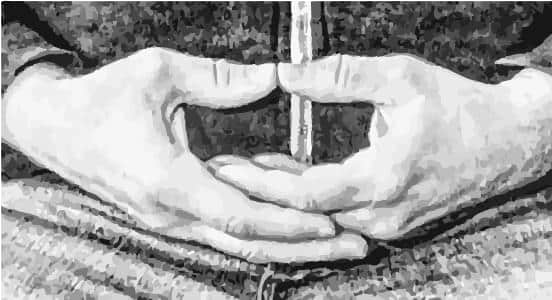
The arms hang relaxed and the hands rest in the lap, forming a kind of circle with the right hand under the left hand - the thumbs touch gently. This hand position is called cosmic mudra called
Sitting on a chair, armchair or sofa
On a chair or in an armchair or sofa, place your feet next to each other on the floor. You can let the backrest support your back in order to stay upright. Sit supple and lively. If you wish, you can form the „cosmic mudra“ with your hands - or place your hands on the armrests.
As soon as you are sitting upright on the chair or on the floor, with your arms and hands comfortably placed, lower your gaze (not your head) without fixing your eyes on anything for any length of time. You can leave your eyes slightly open - or close them completely. You will notice that the „atmosphere“ of sitting is different whether you have your eyes closed or open.
At the beginning of your sitting, take a few deep breaths in through your nose and out through your mouth - as if you wanted to take a deep breath after a run. Then breathe naturally through your nose with your mouth closed - inhalation, exhalation; as the breath may come and go. One right Breathing does not exist.
Make sure you are sitting in a relaxed, peaceful position and leave out everything that goes beyond sitting.
This is the basic physical posture, relaxed without pain, in physical peace. This zazen has been passed down from Buddha to Buddha and from patriarch to patriarch.
Zazen with the mind
Zazen is neither working with a mantra nor visualization. Zazen is not contemplation, not concentration. Zazen is not a mindfulness exercise and neither Zen meditation nor meditation, because there is nothing to meditate on.
All matters may rest, all entanglements may remain entangled. Do not try to become a Buddha. You don't need to form an opinion, for example on how to lie „correctly“ or how to sit „correctly“. Let yourself and everything else be as it is and rest in your sitting.
Thoughts will come with their questions and doubts.
Therefore, follow the example of the Buddhas and patriarchs and think „beyond thinking and non-thinking”.
How?
By feeling at home in both „thinking” and „non-thinking”, but taking up residence „beyond thinking and non-thinking”.
This is the basic mental posture, unstrained and at peace of mind. This zazen has been passed down from Buddha to Buddha, from matriarch to matriarch and from patriarch to patriarch.
Zazen with body and mind fallen away
Thinking”, „non-thinking” and „beyond thinking and non-thinking” relate to each other like parents to their children. Master Dogen also calls this transcendence „parental mind” or „body and mind fallen away”. As an illustration, we can imagine a triangle: the left corner is „thinking”; the right corner is „non-thinking”; and at the apex is „beyond thinking and non-thinking”:


In general, parents love their children equally and favor neither the child named „thinking“ nor the child named „non-thinking“. The parents are not their children, but know them well and know how to guide them and give them their place.
Zazen with „body and mind fallen away” or „beyond thinking and non-thinking” is bliss and joyful samadhi. It is empowering, self-fulfilling samadhi. In this zazen there is an absence of self. Sometimes there is no one who is conscious or not conscious, awake or not awake, there is no coming or going, no knowing or not knowing, thinking or not thinking, beyond all these paradoxes.
Genpo Roshi
Zazen with „body and mind fallen away” is not bound to sitting, standing, walking or lying down. It comes and goes and acts freely, appropriately and in accordance with every situation.
Zazen with „body and mind fallen away” is not the goal or the end of Zen, but its beginning. In daily life, we work on and refine our insight and being at home in „ourselves” - we heal ourselves and the world's misfortune.
This is the life of a Buddha. This life was passed on from Buddha to Buddha and from patriarch to patriarch.