The 10 Sorrows of Siddhartha
What are you saying that's so strange?
Siddhartha Gautama's family and friends
Do you want to leave us?
You thrust a spear into our hearts! [1]

Prologue
Siddhartha suffers from life
It is a humid morning shortly before sunrise. The man had rolled around in his damp clothes and couldn't sleep any longer. He rolls to the edge of the bed and sits up. He puts his hands to his temples as he remembers the night. Twenty young women, beautiful as goddesses, had danced for him and the guests since that evening [2].
Drunk on the intoxication of life, he must have fallen asleep shortly after midnight. The man rubs his eyes with the palms of his hands and stares, still blind, into the darkness. He gropes for the light and lights a candle.
When he looks around him, he is startled: men and women surround him; they are lying next to and on top of each other, asleep. Some have saliva running out of their mouths and staining their bodies. Others are gnashing their teeth, some are babbling and talking confusedly in their sleep, others have their mouths wide open and some have shifted their clothes. The richly decorated hall seems to him like a desolate field of corpses. His existence seems to him like a burning house [3].
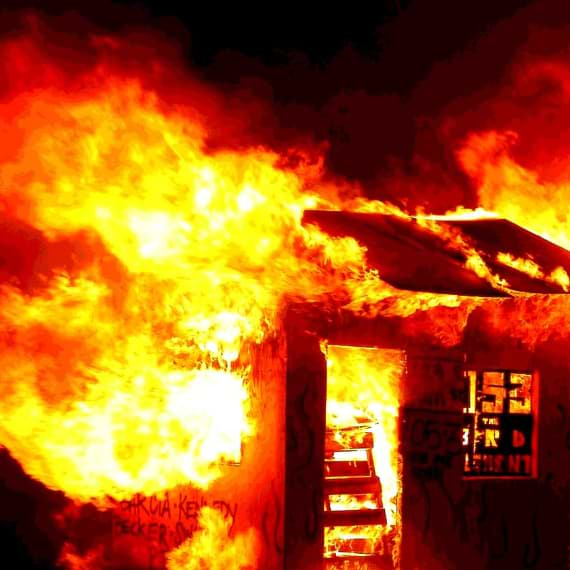
You have to break the chains, now!“ says a voice inside him. The place where he is sitting becomes unbearably hot. The man jumps up and flees the place.
Trembling, he gropes his way past the bodies to his chamber. With trembling hands, he packs eight things: three large ochre-colored cloths for clothing, a bowl of food, a razor, a sewing needle, a belt and a small sieve [4].
Escape is more tempting to him than the life he wants to leave behind. He quietly closes the door behind him and takes a look into his wife's bedroom, who is holding the newborn's head in her hands [5]. „No, I'm not going to take my son in my arms one last time - my wife would wake up and could hold me back: This must not be...“. Are you, Yasodhara, really asleep?
The man wants to leave the house. The dark spirit of doubt [6] tries to hold him back. „Can't I still turn back? All the pain I'm causing? All the comforts I have? Give it all up - for what?“ Beads of sweat trickle down his forehead and he is overcome with trembling and dizziness all over again.
„No - it has to be...“, and with the strength of an elephant [7] he pushes the door [8] on.
Without looking back [9] he throws his luggage over his shoulder on the street and walks towards the rising sun.

First act
The demons of Siddhartha
His family - the Gautama family [10] - had called the man „Siddhartha“ after his birth 29 years ago - „He has reached his goal“ would be our translation.
„Siddhartha Gautama“ - this is the man's full name: „He has reached his goal and leads the herd“.
It seems that his name did not bring him the success it promised until he was 29.
Siddhartha grew up in the household of an Indian „Raja“. Although this title is often translated as „king“, the father's position is more comparable to the president of a German administrative district [11].
The father, Suddhodana Gautama, has precise ideas about what his son should become. He would like Siddhartha to succeed him as regent.
„I want to see my son exercising dominion, power and government over the four continents surrounded by two thousand islands...“ [12]
Suddhodana Gautama
Siddhartha experienced his childhood and youth as a lordly one:
„I lived in nobility, extreme nobility, complete nobility. I had three palaces, one for every weather. I ate the most elegant food and wore the most elegant clothes. From birth I was surrounded by the most beautiful women and the strongest men...“ [13]
The palace offered nobility - and apparent security. For Siddhartha, however, nobility was just a cloak that could be taken from him at any time - and everyone would see the fear and doubt that had taken hold of the child at an early age.
It was then that Siddhartha was allowed to sit next to his father for the first time: The regent looked at his dear son, embraced him, placed him on his lap and sat down on his seat, delighted. At that moment, four robbers were brought in; of these, the father sentenced one to a thousand lashes with thorny whips, the other to be bound and kept in prison, the third to have his body stabbed with spears and the fourth to be impaled. Siddhartha, who is already fearful by nature, becomes even more afraid: „My ancestors did cruel deeds worthy of hell. If I follow my ancestors, my father, and continue to live their lives like this, I will be reborn in hell and endure severe suffering.“ As he thought about this, he was overcome with even greater fear. His golden body became discolored and wilted like a lotus flower touched by the hand.
Fear and doubt have taken Siddhartha as a dwelling place, directing his thoughts in this way:
„It is better for me to dry up and die than to go to the throne. How can I free myself from this house of robbers?“ [14]
From now on, the young Siddhartha pretends to be deaf and mute - at least for a while [15] towards the pleasures and sensual pleasures of the palace. With critical thoroughness [16] instead, he examines the conditions of his life.
No matter how closely he observes, how differently he arranges his experiments and asks the scholars of his time [17], he states as a fact:
„I myself, like my father and mother, my wife and all children are subject to birth, aging, sickness, death and sorrow. Maidservants and servants, goats and sheep, poultry and pigs, elephants, cattle, horses, gold and silver - in short, all things composite - are subject to birth, aging, sickness, death and sorrow.“ [18]
It is, Siddhartha concludes, impossible to find certainty in these composite phenomena:
„It is impossible for me to find security here, in my sheltered life. It is impossible for me to find security in things. It is impossible for me to find security if I follow my father as ruler and regent...“ [19]
and he directs his thoughts in the opposite direction:
„Because I have recognized the danger in what is subject to birth, aging, illness, death and sorrow [20], I must reach the end of the world, its opposite - where one is not born, does not age, does not die, does not leave a previous existence, does not arrive at a new existence.“ [21]

„There is a narrow, safe, ancient path to salvation. On it, the wise, the Brahmin experts ascend to heaven, to freedom from suffering.“
Brihadaranyaka Upanishad
Second act
Siddhartha's escape
The archetype of the monk was known as Prince Siddhartha, from the Upanishads and Brahmanas of the late Vedas [22] and your own encounters [23]. As a child and youth, he must have met so-called Samanas in the city of Kapilavastu. The Samanas had given up all their possessions, wandered around, lived on alms and sought salvation from the cycle of rebirths.
Siddhartha imagined what it would be like if he himself had this Way of the Samanas for the search:
„The life of a householder is narrow and dusty; the life of homelessness is wide and open. While living at home, it is not easy to live the holy life, which is profoundly perfect and pure, like a polished shell. Suppose I shave off my hair and beard, put on the yellow robe and move away from the home life into homelessness.“ [24]
It may have taken years for Siddhartha to struggle with these questions - in the Presentation, what it would be like if...
Perhaps it is no coincidence that he waited with his „world escape“ until he had fathered a son and successor to his family. Conversely, perhaps it is no coincidence that his marriage to Yasodhara remained childless for thirteen years? In any case, the stories give many indications that the birth of his son, whom he Rahula (shackle), was closely linked to his departure into homelessness.
Many years later, when he had become the Buddha, he soberly describes the moment of departure:
„In search of the highest state of sublime peace, I shaved off my head and beard, put on the yellow robe and left home to live without a house, even though my mother and father didn't want me to and cried with tears streaming down their faces.“ [25]
Siddhartha Gautama
Third act
Siddhartha causes tears and suffering
We do not know for certain whether Siddhartha's departure into homelessness took place as described in the Jataka: Secretly and at night. It can be assumed that Siddhartha had discussed his wish with his family - and that he caused great suffering by leaving. We know from the sutras that not only his parents „wept with tears streaming down their faces“, but that incomprehension, anger and reproaches were voiced among family, friends and the people [26]:
Siddhartha's mother lamented:
„It was a misfortune for me to be your mother [Jataka 525, §4] that I gave you life, because you respond to my complaints not taking into consideration [...] leaving the world.“ [Jataka 525, §5]
His father said:
„What kind of virtue is this and what a flight from the world [...], that you are looking after us two old not taking into consideration, [...] leaving the world?“ . [Jataka 525, §6]
and he admonishes Siddhartha to think of his child:
„You have sons too at a tender age, not grown up; when these loved ones don't see you, I think they are in great pain.“ [Jataka 525, §7]
His wife said:
„It was a misfortune for me, [...] that I became your wife, because you respond to my complaints not taking into consideration, [...] leaves the world. [Jataka 525, §11]
Everyone - family, friends and people - is asking the same question:
„Is your heart completely divided or do you have no sympathy for us, that you look after us, the weepers, not taking into consideration, [...] leaving the world?“. [Jataka 525, §9]
The Buddha's answer sounds heartless, although he professes compassion:
„My heart is not completely divided and I feel pity for you; but as I strive for heaven, That's why I want to leave the world.“ [Jataka 525, §10]
and he follows up:
„From this child of mine too, the beautiful, and also from all of you I'll have to part ways later after all.“ [Jataka525, §8]
His friends and confidants summarize the feelings of all those left behind:
„What are you saying that's so strange? You are thrusting a spear into our hearts.“ [Jataka 525, §2]
Representing all those who feel this spear in their hearts, it is Siddhartha's noble white horse that is fatally struck by Siddhartha's departure: the stallion, Kanthaka, goes out of sight and, unable to bear his grief, his heart breaks and he dies. [27]
„Prince Siddhartha left the world and gave up this realm; clad in yellow robes, he walks alone like an elephant.“
The Sakya people, after Siddhartha's flight from the world [Jataka 525, §49]
Epilogue
Do we also have to travel to the end of the world?
Even if the idea of Suddhodana is based on a completely different geographical view of the world [28] than today's, it is astonishing that his wish was fulfilled 2500 years later:
„I want to see my son exercising dominion, power and government over the four continents surrounded by two thousand islands...“
Do we have to physically leave home, farm and family [29] - sometimes leave our continent - to exercise free reign over the continent that we ourselves are?
If we read the history books: some people have to physically leave their homeland, some do not.
However, everyone must travel to the end of the cosmos. The Buddha, when asked whether one could attain liberation by traveling, replied:
„I tell you, friend, that it is not possible by traveling to see or reach the far end of the cosmos, where there is no birth, old age, death, passing away or reappearance. But at the same time, I tell you that there is no ending of suffering without reaching the end of the cosmos. Yet it is just within this plaintive body, with its perception and mind, that I declare that there is the cosmos, the origin of the cosmos, the cessation of the cosmos, and the path of practice leading to the cessation of the cosmos.“ [30]
Master Dogen describes the journey like this: „When Siddhartha climbed over the city wall and went into the mountains, he gave up one mind and entered another mind. When you make this mind your eyeballs, you borrow the breath of the buddhas and patriarchs and imprint the seal of living experience on all dharmas.“ [31]
Friends, Sangha - let's travel together, climb the city walls, breathe the breath of the Buddhas and seal our living experience...

Footnotes
[1] Jataka 525, §2 | The Little Tale of Sutasoma | Jātaka tales are part of the discourses in the Pali canon Ⓘ. There are translations into Sanskrit, Tibetan and other languages. According to tradition, the stories go back to Ananda, a disciple of the Buddha. A Jātaka („birth story“) is a story from the life of the historical Buddha, Siddhartha Gautama; later, however, more and more teaching stories were added that refer to earlier existences and other forms of existence of the Buddha. | Wikipedia | ↑
[2] Jataka Avidurenidana - The not distant introduction | J b2.06 - The escape from the world §271 | ↑
[3] ibid. | ↑
[4] ibid. §273 Then the Bodhisattva Siddhartha thought, „These fine cotton robes of mine are not fit for a mendicant monk.“ Then the archangel Ghatikara, who had been a friend of the Bodhisattva at the time when Kassapa was the Buddha and whose friendship had not waned in the whole time until the appearance of the next Buddha, realized the following: „Today my friend is performing the great world renunciation; I will take the equipment of a mendicant monk and go to him with it.“ „The three robes and the bowl, the clipping knife, needle and belt, plus the strainer: these eight are what a monk devoted to devotion needs.“ So he took these eight items of equipment of a mendicant monk and gave them to him. The bodhisattva put on the badges of the saints and received the exalted robes of the monkhood. | ↑
[5] ibid. §271 | ↑
[6] ibid. § 271 Mara is the antagonist of Siddhartha and the later Buddha Shakyamuni as the principle of the „tempter“ and the embodiment of „that which causes suffering“. Mara appears here in an attempt to persuade Siddhartha to repent: Standing in the air, he shouted, „Venerable one, do not go away! After seven days, the wheel of world domination will show itself to you; you will gain dominion over the four continents surrounded by two thousand islands. Turn back, venerable one!“ [...] Then the Bodhisattva said: „Mara, I realize well that the wheel of world dominion would show itself to me; but I do not need dominion. I will [...] become a Buddha.“ To this Mara replied: „From now on I will recognize in you every thought of lust or ill-will or injury as soon as it is conceived“; and in order to discover a fault in him, he attached himself to him like a shadow without going away. The bodhisattva, however, rejected the prospect of his dominion over the world like a lump of saliva and left the city. | ↑
[7] Jataka 525 - J 525 [Cullasutasoma-Jataka] | „He [Prince Siddhartha] left the world and gave up this realm; clothed in yellow robes, he walks alone like an elephant.“ | ↑
[8] Jataka Avidurenidana - The not distant introduction | J b2.06 - The escape from the world §271 | [Siddhartha] came to the great city gate at midnight. Now the king had thought, „There is no way [Siddhartha] will be able to open the city gate and escape,“ and had arranged it so that each of the two gate wings could only be opened by a thousand men. But [Siddhartha], endowed with strength and power, possessed the strength of ten thousand million elephants, and the strength of a hundred thousand million men. [...] But a deity dwelling at the gate opened the gate [without Siddhartha having to use these powers]. | ↑
[9] We frequently encounter the motif of refusing repentance and consideration as a sign of Siddhartha's determination in the early texts. The introduction to the Jataka states: „Then he felt like looking at the city again. But when his mind thought of it, the great earth burst as if to say, „O hero, it is not fitting for you to stop and look back,“ and turned like a potter's wheel.“ Jataka Avidurenidana - The not distant introduction | J b2.06 - The escape from the world §271
In the Cullasutasoma Jataka, Siddhartha refuses to show any consideration to his relatives and friends:
„Is your heart completely divided, or do you have no compassion for us, that you do not take us, the weeping, into consideration, Prince, and leave the world?“
Siddhartha replies:
„O [...] do not weep, do not be sad with forest-dark eyes! Go back to the palace, for I will leave here without consideration.“
Jataka 525 - The Tale of Sutasoma (Cullasutasoma-Jataka) | ↑
[10] Wikipedia: Siddhartha Gautama | Gautama or Gotama means „leader of the herd“ or „greatest bull“. However, the name was also comparable to our family names - it indicated membership of the Gautama clan (Sanskrit: Gautama gotra, Pali: Gotama gotta), whose members could all be addressed in this way. | ↑
[11] Hans Wolfgang Schumann, Der historische Buddha. Leben und Lehre des Gotama, Diederichs gelbe Reihe 73, 7th edition, Munich 1999, p. 31 f. | The Chinese Hsüan-tsang gives us an idea of the size of the republic administered by Suddhodana. The Sakiya region, he writes, had a circumference of 4000 Li = about 1880 km and included ten cities - which our traveler found destroyed and abandoned in the 7th century AD. The city of Kapilavatthu was protected by a wall of 15 li = approx. 7 km in length, which is still preserved in the brick foundations. Apparently, these ten cities are largely identical to the nine mentioned in the Buddhist texts as Sakiya cities, namely, apart from Kapilavatthu: Devadaha, Catuma, Samagama, Khomadussa, Silavati, Medatalumpa, Ulumpa and Sakkara. These may have been district towns, each of which served as a market and trading center for a number of villages. Hsüan-tsang's information allows us to draw conclusions, albeit only very roughly, about the area and population of the Sakiya Republic. Its surface area may have been around 2000 square kilometers, of which a considerable part was jungle and unused for agriculture. If we assume an average population density of 90 inhabitants per km2 for the fertile area of central Tarai, based on today's higher figure, this results in a total population of 180000 people, of whom 8000 may have lived in Kapilavatthu and 4000 in each of the eight (or nine) district towns. Around 40,000 people of the Sakiya Republic would therefore have been townspeople, the remaining 140,000 villagers. The warrior nobility may have included 10,000 people who largely lived in the cities but, like the majority of the population, were engaged in agriculture. | ↑
[12] Jataka Avidurenidana - The Not Distant Introduction | J b2.04 - The Naming §270 | „I want to see my son exercising dominion, power and government over the four continents surrounded by two thousand islands and walking under the surface of the sky surrounded by a retinue covering thirty-six yojanas in circumference.“ | ↑
[13] Anguttara Nikaya 3.38 - Suhamala Sutta: Nobility | ↑
[14] Jataka 538 (§B) - The Tale of the Mute Cripple (Mugapakkha Jataka) | ↑
[15] ibid. | ↑
[16] Hans Wolfgang Schumann, Der historische Buddha. Leben und Lehre des Gotama, Diederichs gelbe Reihe 73, 7th edition, Munich 1999, p. 35 f.: Whether Siddhartha was a literate person is questionable. Although a late legend claims that he amazed his teacher by the ease with which he learned to master the Indian alphabets, the fact is that the Pāli canon contains no indication that the Buddha was able to read. In his time, the ability to read was regarded as a useful skill, albeit not an elementary one, especially as there were no written books due to the lack of suitable writing materials[...]. The attitude of the adult Siddhattha to the question is clear from his instruction to the order that it was not appropriate for a monk to practise skills such as writing; the monk was to be concerned solely with salvation (Udana 3,9: „He who lives without practicing an art, without burden, intent on his salvation, a sensualist redeemed in every respect), - the homeless one to whom nothing belongs, the desireless one who, having beaten Mára, walks alone, - he is a monk.“ [UDANA - The Book of Solemn Words of the Exalted One. A canonical scripture of Páli Buddhism. In the first German translation from the original text by DR. KARL SEIDENSTÜCKER]. From Siddhattha's lifelong interest in spiritual and intellectual matters, one may conclude that he had little difficulty in acquiring the important subject matter for a Khattiya scion. His education was greatly aided by his frequent attendance at council meetings and court hearings, at which his father presided. The council hall trained Siddhattha's intelligence and taught him fluency and precision of expression. His intellectual development was, of course, accompanied by the development of character traits that may have worried his realistic father and alienated him as supposed signs of weakness, namely sensitivity and a tendency towards reflection, perhaps brooding. The realization that life is not always pleasant and that transience and suffering (dukkha) lurk behind all happiness (sukha) did not come to Siddhattha only shortly before his departure into homelessness, as the legend would have us believe, but already assailed him as a teenager when he was still living in the care of his family, free from external worries. Siddhartha, who became a Buddha, reports on this time in Anguttara Nikaya 3.38 - Sukhamala Sutta: Nobility: Even though I was endowed with such happiness, such utter nobility, this thought arose in me: ‚When an uninstructed, commonplace person, himself subject to death, not having transcended death, sees others dead, he is horrified, humiliated, & disgusted, oblivious to himself that he too is subject to death, not having transcended death. If I, who am subject to death, were not beyond death, horrified, humiliated, and disgusted, it would not suit me‘ When I realized this, the [typical] intoxication of a person in life fell away from me completely. | ↑
[17] The Buddha had five different teachers before his enlightenment, according to the Milandaphana 4.6.1 (The questions of Milinda): Those eight brahmanas, O king, who examined the bodily features of the just-born Bodhisatta - as Kāma, Dhaja, Lakkhana, Mantī, Yañña, Suyāma, Subhoja and Sudatta - and who reported on his welfare and supervised him: these were his first teachers. Furthermore, the brahmana Sabbamitta, who was of noble and distinguished lineage and was a linguist, a grammarian, versed in the six auxiliary books of the Veda, whom the Bodhisatta's father Suddhodana had fetched at that time and, while pouring holy water from a golden vessel, gave to the boy as a teacher: this was his second teacher. Furthermore, that deity who made the Bodhisatta restless and whose words the Bodhisatta heard, having become restless and agitated, went forth at that moment and renounced the worldly life: this was his third teacher. Furthermore, after his departure into homelessness, Alāra Kālāma, who showed him the way to the meditative realm of neither-perception-nor-non-perception (see jhāna): this was his fourth teacher. His fifth teacher, however, was Uddaka Rāmaputta. According to this report, we count 10 teachers before the Buddha went into homelessness. | ↑
[18] Anguttara Nikaya 3.38 - Suhamala Sutta: Nobility and Majjhima Nikaya 26, 5-12 | ↑
[19] According to the sense, e.g. Anguttara Nikaya 3.38; Majjhima Nikaya 36; Jataka 525, or Jataka 538 | ↑
[20] Majjhima Nikaya 26, 13 | ↑
[21] Anguttara Nikaya 4.45 - Rohitassa Sutta | ↑
[22] The Brahmana Sabamitta, well versed in the Vedas, was one of Siddhartha's earliest teachers (see footnote 17 and here: Milandaphana 4.6.1 (The questions of Milinda)). Sabamitta also gives Siddhartha the Brihadaranyaka Upanishad (see also here), which states: There is a narrow, safe, ancient path... that I have found. On it, the wise, the Brahmin experts ascend to heaven, to the Redemption. On it, they say, is white, blue, yellow, green, red. This is the path that is found through Brahman; on it the knower of Brahman walks glowing and doing pious works. | ↑
[23] In the Jatakas, the encounter with a monk is described like this: Now on another day, as the Bodhisattva was driving to the park, he saw a monk created by the deities, properly clothed above and below, and he asked the charioteer, „Who is this, dear one?“ Now the charioteer, because there was no Buddha yet, did not know a monk and the advantages of monasticism; but on the inspiration of the gods he said, „It is a monk, O prince,“ and extolled the virtues of monasticism. The Bodhisattva took pleasure in the world's refuge... Jataka Avidurenidana - The not distant introduction | J b2.06 - The escape from the world §271 Siddhartha grew up in the 6th century BC in the area of conflict between the old traditional Vedic-Brahmanic sacrificial cult on the one hand and the various emancipatory movements such as the Aupanisadas, materialists, ascetics and wandering mendicants on the other. The Samanas, who opposed Brahmanism, the authority of the Vedas and the caste system and sought salvation from the cycle of rebirths (moksha) away from these institutions, were the most popular. Numerous ascetics went out into the forests to meditate and, in the course of their renunciation of the world, to attain liberation from samsara through their own efforts. In this way, groups were formed, some with a considerable following, who saw their teachings as an enlightened alternative to established Brahmanism. Siddhartha gained his convictions from contact with all these groups. (cf. Wikipedia). | ↑
[24] Majjhima Nikaya 36, 12 | ↑
[25] Majjhima Nikaya 26, 15 and Majjhima Nikaya 36, 14 | ↑
[26] The events are described particularly vividly in the „Little Tale of Sutasoma“ (Cullasutasoma Jataka), from which the following verses are taken. Although the Buddha tells a story from a previous life, he ends his speech with the words: At that time the parents were members of the great royal family, Canda was Rāhula's mother, the eldest son was Sariputta, the youngest son was Rāhula, the nurse was Khujjuttara, the great merchant Kulavaddhana was Kassapa, the chief commander was Mogallana, the prince Somadatta was Ananda, but the king Sutasoma was me. The paragraphs refer to this translation: The Little Tale of Sutasoma, Jataka 525 | ↑
[27] Jataka Avidurenidana - The not distant introduction | J b2.06 - The escape from the world §273 | ↑
[28] Over the centuries of the Vedic period, cosmologies became more and more complex. However, the basic structure of the cosmos remained more or less the same. Both Hinduism and Buddhism share the concept of the central axis or world mountain Mount Meru in Sanskrit, Sumeru in Pali. This is surrounded at the four cardinal points by four continents, one of which is inhabited by humans. The universe, which is connected vertically by Mount Meru, is divided into three superimposed levels. The underworld and the hells form the lowest level, the human world the middle level and the heavens the highest. All these levels are usually divided into several sub-levels. | ↑
[29] An important detail is worth mentioning at this point: the Buddha himself had left his family - against the resistance of his parents. Knowing the pain he himself had caused (and the destructive economic consequences that the departure of a breadwinner into homelessness could have), he only allowed ordination into his Sangha if the candidate could produce permission from his parents: „Have you received permission from your parents, Raṭṭhapāla, to go forth from the home life into homelessness?“ „No, venerable sir, I have not received permission from my parents.“ „Raṭṭṭhapāla, Tathāgatas do not give permission to go forth into homelessness to anyone who has not received permission from his parents.“ (Majjhima Nikaya 82, 6) and also in the Vinya: „Do you have your parents“ permission?„ Aspirant: “I have, Venerable Sir!" PATIMOKKHA- Upasampadakamman - The Act of High Ordination, paragraph 11 | ↑
[30] Anguttara Nikaya 4.45 - Rohitassa Sutta | ↑
[31] Master Dogen: Shobogenzo. The Treasury of the True Dharma Eye. Heidelberg-Leimen, 2003. chapter Shinjin gakudo, volume 2. p.281 | ↑