What is Kanzeon?
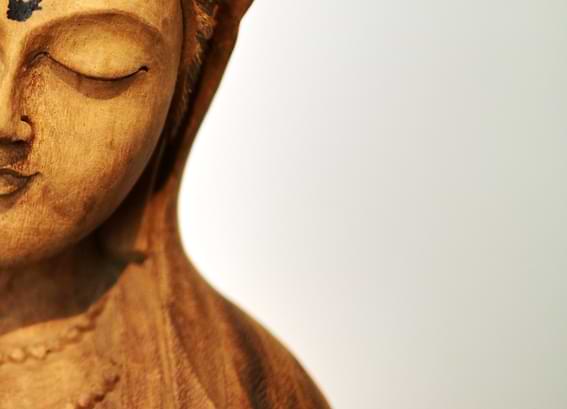
Kanzeon's origin
She was sitting on top of a cupboard. I put my hands on the window like blinders so that I could see better into the salesroom in the dark. A store for incense, Asian goods and fine scarves in Düsseldorf's old town. I had never seen one like her before. I wasn't sure: was it a Kanzeon?
At the time, we were looking for a statue for our Kanzeon seating area on Helmholzstraße. As it is when you're looking for something, it suddenly appears everywhere. I saw Kanzeon everywhere.
I was on my way home from sitting, we had just been talking about buying a statue. Shaking my head, I walked on. Was it a canceon?
In Buddhism, Kanzeon is the name for the embodiment of compassion. Kanzeon is compassion and belongs to the family of bodhisattvas. But what is a bodhisattva?
Buddhism tells the story of our existence as human beings - a family story. Many members of the family appear in this story. One of them is “Buddha”. Buddha has freed himself from all attachments and therefore from all suffering. That is why Buddha no longer likes to act - not even to teach.
The Mahavagga tells us how Shakyamuni Gotama, who had just become Buddha, spent 49 days in the “bliss of liberation” and everything was “equally valid” for him. The king of the Hindu gods, Brahma Sahampati, seven weeks after his enlightenment, had asked - no: begged - the Buddha to inform the world of his discovery.
Not willing, something the Buddha told the god Brahma not to do this:
“What I have achieved through toil - enough! Why proclaim? That would be exhaustion for me, that would only be torment for me. Brahma, my mind is inclined to indifference, not to the exposition of the teaching.“ [1]
The Buddha to Brahma
The Buddha, finally, allowed himself to be persuaded and, out of compassion for the other beings, decided to explain his “Dharma” to them. He chose to return to the world - and thus Torture and suffering. Since then, he has also worked as a bodhisattva.
Sitting next to the Buddha Family table the Bodhisattvi or Bodhisattva - also freed from most attachments, but with the wish, act for the benefit of all beings. Act to want itself is an attachment and causes suffering. Knowing that they must return to the world of suffering in order to work, choose the Bodhisattvas/is the suffering.
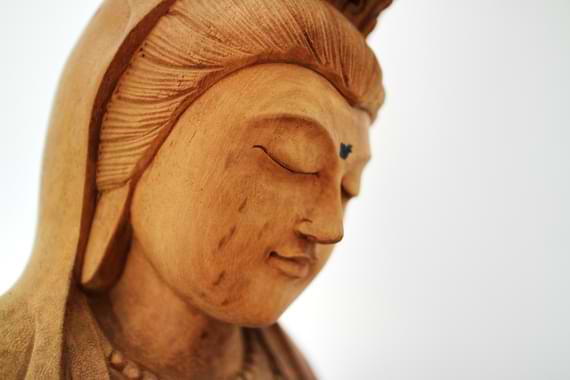
Kanzeon as a member of the Bodhisattva family
If it was a statue of the Kanzeon, then I didn't like it. There was something wrong with the proportions, the posture - no, I didn't like it.
The next day, I was drawn - somewhat - to the old town. I headed straight to Ratinger Straße, to the store selling Asian goods, scarves and incense. The little bell on the door summoned the owner. I asked if we could take down the figure on top of the cupboard together. Of course we could.
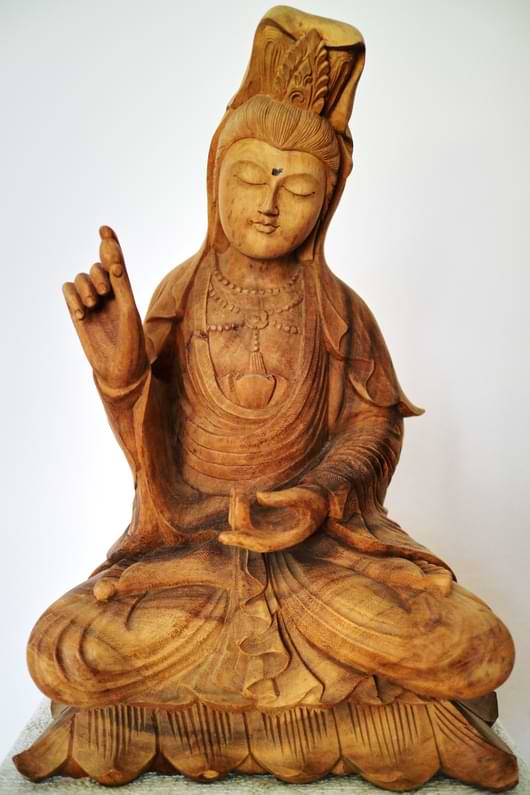
Our Kanzeon was - and still is - heavy.
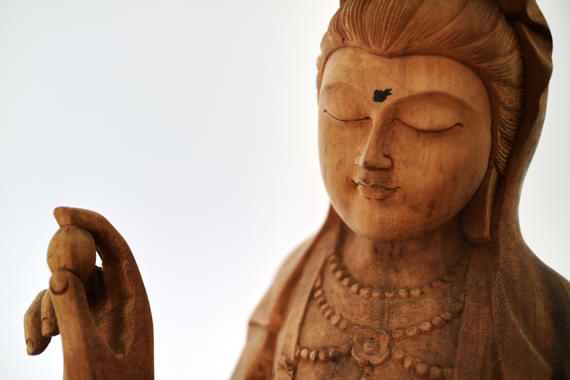
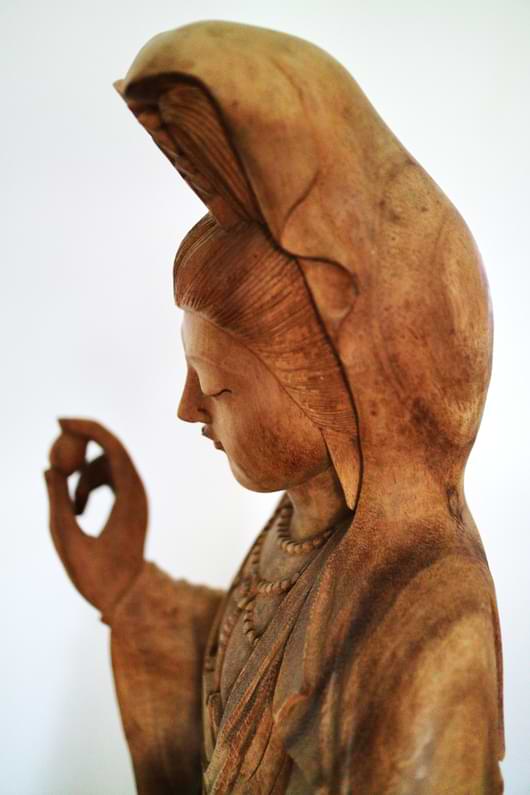
I didn't like her. What was that in her right hand? And somewhat crudely carved, it seemed to me. And the proportions...
There are many Bodhisattvas. Kanzeon is the bodhisattva of whom there are the most different manifestations in Buddhism.
Other manifestations of Kanzeon are Avalokiteśvara, “the Lord who looks down”. The bodhisattva who “sees” or “perceives” (kan 觀) the “sounds” or “cries” (on音) of the “world” (ze 世) and responds with compassion (jihi 慈悲) to save beings from all kinds of misfortune and suffering. It is said, Tara (तारा ) is the essence of compassion because it was born from the tears that Avalokitesvara shed out of compassion for all beings.
I spent a few days visiting the store at different hours. I didn't like the statue, but it attracted me. Finally, I called our then chairwoman (and now honorary chairwoman) Linda Lehrhaupt [2]and told me about the statue. We arranged to meet the next lunchtime in Ratinger Straße.
„I don't really like the statue - there's something wrong with the proportions... let's leave it...“ Linda said to me. I was glad. A decision at last.
In Japan, Kanzeon is called „Kannon Bodhisattva“ (Kannon Bosatsu 觀音菩薩) and „Kanjizai Bodhisattva“ (Kanjizai Bosatsu 觀自在菩薩). Images of Kanzeon take many different forms in East Asia, where despite the fact that Avalokiteśvara is a masculine noun in Sanskrit, this bodhisattva was understood to be a female figure associated (among many other things) with maternal kindness, assistance in childbirth and the protection of children. Images of the Eleven-faced Kannon (Jūichimen Kannon 十一面觀音) and the Thousand-handed Kannon (Senju Kannon 千手觀音) - an eye in the palm of each hand - illustrate the ideas that Kanzeon can look anywhere and is equipped with the expedient means (hōben 方便) needed to respond effectively to any kind of emergency [3].
chinese: Guanyin 観音/观音 or Guanshiyin 觀世音/观世音(„perceiving the sounds of the world“);
korean관세음 Kwan(se) Um or Gwan(se)-eum (with the same meaning as in Chinese);
Japanese聖観音 (Sho-)Kannon, also 観世音, Kanzeon („hearing the voices of the world“) or older Kanjizai or Kōzeon (光世音, „the voice of the world of light“);
Tibetanསྤྱན་རས་གཟིགས, Spyan ras gzigs, pronunciation: Chenrezi, also Chen rezig [German: Tschenresi(g)];
Mongolianᠨᠢᠳᠦ ᠪᠡᠷ ᠦᠵᠡᠭᠴᠢ, Nidubarüsheckchi, ᠵᠠᠨᠷᠠᠶᠢᠰᠢᠭ, Жанрайсиг, Dschanraisig;
vietnamese: Quán Thế Âm [4].
What does Kanzeon do?
Two days later Linda called me: „I've been on Ratinger Strasse every day“ she said. „She won't let me go - we should invite the statue to our Zendo“.
The next day, we met with the whole board in the Asian store with the incense, the scarves - and the canteen.
Nobody really liked it. Only Linda and I were in favor of buying it.
The Management Board refused. „We will find a better figure!“ was the decision.
Later, many weeks later, the owner of the store told me: „Well, it really annoyed me that several people turned up every day and wanted to see the figurine. I didn't even put it on top of the cupboard any more. I'm glad that you've finally made up your mind. And I'm delighted that this beautiful figurine now has a place in your club...“
Kanzeon has its dwelling place in every human being and places compassion alongside the Buddha, for whom everything is equally valid.
Is Kanzeon's main occupation meditating?
If she had the time: yes.
But no: it hears the cries of the world and is constantly on the move with its thousand arms, its thousand eyes and thousand ears to give: comfort to the mourner, drink to the drinker, a vaccination to the corona sufferer, proof to the denier - and help to every sufferer.
Buddha relates to Kanzeon like the father to the mother or the Great spirit to the Big heart.
Footnotes
[1] Mahāvagga Vinaya, Chapter 1 Section 5 | ↑
[2] Many of us at Kanzeon Sangha Deutschland e.V. started with Linda Myoki Lehrhaupt in the late 1980s and early 1990s. Some at the adult education center, because Linda led the „Zen Meditation“ course there. I also attended one of her courses in 1988.
Linda introduced us to sitting - and to philosophy: she played a game with us, a Zen game with unsolvable questions. »Don't think that I want to ask you a difficult question - but I want to know from each of you, what does one and one mean to you personally?«
Everyone was silent and thinking.
»The universe and the individual?« someone asked.
»I see,« she said.
»God and man?« answered another.
»Mmmh...« she said.
It went around and everyone had found something: »...the deepest truth?«, or: »...I'll sit with it!«.
I wanted to be particularly clever and came up with a really Zen answer, short and direct: »Me and you!«
»TWO!!! Two!« shouted Linda in her American accent, pointing two fingers up. »One and one is TWO!... Isn't ONE AND ONE two for each of you?!... My teacher keeps playing this game with us in other forms, and everyone falls for it and says I and you or the law within us and the stars above us... but Zen is no more mysterious than: One and one is two.«
That was the first authentic Zen teaching I received, via Linda, directly from Genpo Roshi and from the Zen tradition. My ears turned red and I felt ashamed - »one and one« was »me and you«? Someone had thrown out the bait and I had taken the bait.
Since 2012, Dr. Linda Myoki Lehrhaupt, Sensei, has been the leading teacher of the Zen Heart Sangha, an inter-European group of Zen practitioners based in Germany.
Linda's Biography
To Zen Heart Sangha | ↑
[3] Glossary of the Soto School | ↑