Streets, Zen and bodybuilding 3
The first morning zazen has just started and I remember: so far we have entered the zendo, before six o'clock in the morning; we have settled on our cushions, the Roshi has greeted us with Kentan and now the first 40 minutes of zazen have begun...
Preview: 6:00 a.m.: Does Roshi know the answer? / 6:04 a.m.: How did I end up here? / 6:05 a.m.: I taste my hunger... / 6:09 a.m.: ...hunger for posture / 6:11 a.m.: How the Buddha sits / 6:14 a.m.: Breath counting and bodybuilding / 6:19 a.m.: »Find my mind« / 6:21 a.m.: Zen at the adult education center / 6:24 a.m.: We become Zen students / 6:30 a.m.: We imagine the world well / 6:32 a.m.: The monk / 6:37 a.m.: Why doesn't the barbarian have a beard? / 6:40 a.m.: We get up.
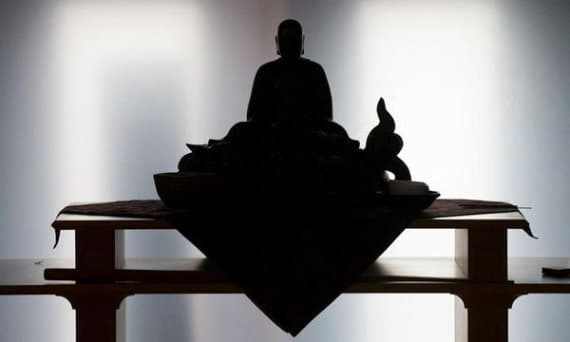
6.04 a.m.
How did I end up here? I sit with my legs crossed on a small round cushion and have forty minutes of motionless silence in front of me. Then thirty minutes and thirty minutes again - day after day.
Shakyamuni Buddha comes to mind:
„And if only bones remain of me, if my blood and my innards wither away: I will not get up until I have seen through the truth!“ [1]
he had vowed over 2500 years ago when he sat down under the Bodhi tree to solve the questions of his life. I wish for this determination, this courage.
Back then, over ten years ago, I had only planned to sit for a quarter of an hour. I had found photos of how to sit in a book. I didn't have a cushion like the one described there. In the book, they called this cushion filled with kapok or buckwheat husks, which you were supposed to push under your bottom, zafu. Instead of the zafu, I took an old blanket, rolled it tightly and wrapped a belt around it to keep it in place. I put another blanket under my knees. I was alone. It seemed strange what I was trying to do, so I made sure I was alone. I wanted to sit on this rolled blanket and cross my legs in front of it as far as I could. I then wanted to cross my hands in my lap, keep my back upright and hold out for fifteen minutes with my eyes open without moving. I wanted to do this without a spectator, because it seemed ridiculous to me.
I had read that sitting like this, za-zen, the Buddha's posture, was »the heart of Zen«. Only from this posture can enlightenment be achieved and 2500 years of Zen and Buddhism be understood.
I sought knowledge and enlightenment, the truth about life and death, and liberation from pain and suffering. Zazen promised medicine.
As soon as my bottom touched the ceiling and my legs were crossed, I was overcome by a gray emptiness. After minutes, I noticed my ankles digging into the floor. My breathing was unsteady and I felt a boredom that frightened me. In the emptiness, thoughts and sensations whirred up and down and back and forth.
I had read that the old masters gave beginners the task of counting their breath. Counting? How, when I had to think about boredom? When boredom was mixed with dissatisfaction! Blood rushed in my ears and spit collected in my mouth.
„Was that me?“
I looked up and saw the carpeted floor of my bedroom in front of me. Where was I? What was I doing?
My legs hurt. I could no longer feel my toes! Was that dangerous? How long had I been sitting in boredom? Two minutes? Ten minutes? I checked my watch: nine minutes left! My back groaned. I was bored. Bored to death. Counting my breath made my stomach ache. Every breath a reluctance.
Was that me?
Boredom and pain. I knew that. Nothing heroic.
Pain and boredom. Nothing sacred. I felt at home.
It repelled me and it attracted me, sitting in its boredom and pain. Was that me? I had heard the lion's call. I didn't like what I had seen, but I wanted to see it again.
The next day, I secretly sat on the rolled blanket for another fifteen minutes. The day after that again, and since then I have continued to sit until today, here in the zendo of the American Zen master Genpo Merzel Roshi, abbot of the international Zen community Kanzeon Sangha.
My questions, have they been answered?
6.05 a.m.
My nose itches. The last chime has just died away. Deep silence fills the hall. Over fifty people are sitting close together and have decided to spend an entire week together in this posture, in silence, and to burn off their brooding and greed in this silence: Sesshin.
I take a mental tour of my body to detect and correct tension. I feel a small pain under my left shoulder blade, a pulling or stinging sensation a centimeter inside the muscle. I exhale deeply and imagine adding the pain to my breath. I read this in a book on meditation years ago. But it doesn't help. Nothing I've read helps. I had read my whole life in search of the answer to how to live my life properly and how to die properly. I read all the adventure books, by Karl May and Fedor Dostoyevsky, Thomas Mann, Goethe, Plato and the others. And I read them all, the meters and meters of literature about Zen.
There was something in the Zen books about the great liberation. I had read about old masters who could stop the most terrible warriors with a wrinkle of the eyebrow, or who tamed oxen and were simply themselves in marketplaces.
»I had read «Being myself...». I longed for that. «Myself" - without fear and without pain. I had enough pain.
But: »Who am I?«
That was my illness: »Who am I?« I didn't like where I came from. I didn't like where I was going. I was hungry. It wasn't the food I was missing. I had enough to eat. I ate and was not full. I drank and became more and more thirsty.
I was looking for security, for relaxation, for a fresh breath, for a clear morning. Unsatisfied I was, and even when a fresh breath cooled my lungs, on a clear morning, my beloved next to me - I could not be happy, because I knew this happiness is short-lived, it can be taken away and the greed will return.
„Is that me?“
My right and left neighbor and everyone else here in the meditation room, in the zendo, know the disease. The Buddha diagnosed it and called it the »truth of suffering«. Many have taken medicine. Food. Smoking. Drinking. Sex. Diet. Work. Discipline. Asceticism. Destruction of body and mind, the six years of mortification of Shakyamuni Buddha - severe side effects, no escape, no answer!
When I had sat on my rolled-up, worn blanket for the first time, I had tasted my hunger. But an answer - an echo - had resounded from the depths:
„Yes, that's me“
I felt nourished.
Footnotes
[1] Jataka b2.08 | The Day of Enlightenment | ↑
[Siddharta] turned the place from the right, went to the east side and stood there, facing west. On the east side, however, is the place for the seat of all Buddhas; it did not tremble or waver. Then the great being realized: „This is the place not abandoned by all Buddhas, not wavering; this is the place where one destroys the cage of lusts.“ He took the grasses at the top and spread them out. Immediately a cushion seat of sixteen cubits was formed. The grasses lay down in such an order that even a very skillful painter or clay artist could not have drawn them. Thereupon the Bodhisattva left the trunk of the Bodhi tree at his back and, turning to the east, made the following firm resolution: „Gladly shall my skin, my muscles and my bones dry up, and the flesh and blood in my body shall dry up; but I will not give up this seat without having attained complete enlightenment.“ So he took up the crossed-legged position, the invincible one, indestructible even by the impact of a hundred thunderbolts, and sat down.
Jātaka tales are part of the discourses in the Pali canon Ⓘ. There are translations into Sanskrit, Tibetan and other languages. According to tradition, the stories go back to Ananda, a disciple of the Buddha. A Jātaka („birth story“) is a story from the life of the historical Buddha, Siddhartha Gautama; later, however, more and more teaching stories were added that refer to earlier existences and other forms of existence of the Buddha. | Wikipedia | ↑
This article is part 3 of the series „Streets, Zen and bodybuilding“
- Streets, Zen and bodybuilding 1
- Streets, Zen and bodybuilding 2
- Streets, Zen and bodybuilding 3
- Streets, Zen and bodybuilding 4
- Streets, Zen and bodybuilding 5