Streets, Zen and bodybuilding 4
The first morning zazen has just begun and we are already hungry - hungry for the posture.
Preview: 6:00 a.m.: Does Roshi know the answer? / 6:04 am: How did I get in here? / 6:05 am: I can taste my hunger... / 6:09 a.m.: ...hunger for the attitude / 6:11 am: This is how the Buddha sits / 6:14 am: Breath counting and bodybuilding / 6:19 am: »Find my mind« / 6:21 am: Zen at the adult education center / 6:24 am: We become Zen students / 6:30 am: We imagine the world well / 6:32 am: The monk / 6:37 am: Why doesn't the barbarian have a beard? / 6:40 am: We get up.
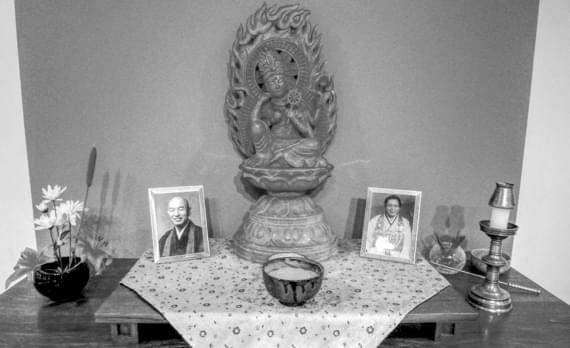
6.09 a.m.
I breathe in: One. I breathe out: Two. I return to my breath, onto my pillow and quietly draw the dark air of the morning into my nose. The windows are open in our zendo. The Roshi likes it cool because he sweats easily. Meditation generates energy, so you can get hot. I can tell by the huge portions I burn off at lunchtime. I eat twice from the large pots. Mountains of rice and vegetables pile up on my plate.
I'm hungry. I'm looking forward to the morning. In over two hours, at just after eight, there will be breakfast. It's a good thing I had a coffee in the lounge this morning - I want something hot in my stomach. A cigarette wouldn't be bad either. But I have stopped smoking. Coffee and cigarettes don't fill the emptiness I feel on the meditation cushion. We still have three periods ahead of us, in the posture of Buddha, before the palate will taste breakfast.
Now, shortly after six, I can taste the Buddha's posture. This posture has been handed down for two and a half thousand years and Genpo Roshi, as the 81st patriarch of Zen, brings the posture to us in a direct line of transmission from Shakyamuni Buddha via Bodhidharma, Dogen Zenji and Taizan Maezumi Roshi.
After six years of searching and the strictest asceticism leading to near death, Shakyamuni Buddha realized that he would not receive an answer to his questions in this self-destructive way and broke off his mortifications.
„Thus, in my search for knowledge, I came to a delightful spot on earth with a graceful grove where the river flows silvery, surrounded by beautiful banks, in whose surroundings human dwellings promise food. So I settled there with the thought: This is enough for the pursuit of immersion.“ [1]
Shakyamuni Buddha seems to have been an extreme person, with tremendous will and aspiration. Perhaps his inner pressure and desperation were also higher than most of us. When he found this lovely place and settled down, he made the vow we have already heard about:
„And if only bones remain of me, if my blood and my innards wither away: I will not get up until I have seen through the truth!“ [2]
There must be a power of its own in the posture that is vouched for in so many images of the Buddha, in so many statues; and that the Zen masters teach and pass on. It was in this posture that Shakyamuni experienced his realization and became the enlightened one, the Buddha. The posture as such, it is said, is already enlightenment.
I chew on this thought and look up, startled: facing me are ten or more Buddhas sitting in the majestic posture and I feel fifty others around me. Furtively, I turn my eyes to Roshi; a mountain that dreams. Every now and then he tilts his head to one side as if to chase away some tension.
Footnotes
[1] Majihima Nikaya, 26 §17 | ↑
[2] Jataka b2.08 | The Day of Enlightenment | ↑
[Siddharta] turned the place from the right, went to the east side and stood there, facing west. On the east side, however, is the place for the seat of all Buddhas; it did not tremble or waver. Then the great being realized: „This is the place not abandoned by all Buddhas, not wavering; this is the place where one destroys the cage of lusts.“ He took the grasses at the top and spread them out. Immediately a cushion seat of sixteen cubits was formed. The grasses lay down in such an order that even a very skillful painter or clay artist could not have drawn them. Thereupon the Bodhisattva left the trunk of the Bodhi tree at his back and, turning to the east, made the following firm resolution: „Gladly shall my skin, my muscles and my bones dry up, and the flesh and blood in my body shall dry up; but I will not give up this seat without having attained complete enlightenment.“ So he took up the crossed-legged position, the invincible one, indestructible even by the impact of a hundred thunderbolts, and sat down.
Jātaka tales are part of the discourses in the Pali canon Ⓘ. There are translations into Sanskrit, Tibetan and other languages. According to tradition, the stories go back to Ananda, a disciple of the Buddha. A Jātaka („birth story“) is a story from the life of the historical Buddha, Siddhartha Gautama; later, however, more and more teaching stories were added that refer to earlier existences and other forms of existence of the Buddha. | Wikipedia | ↑
This article is part 4 of the series „Streets, Zen and bodybuilding“
- Streets, Zen and bodybuilding 1
- Streets, Zen and bodybuilding 2
- Streets, Zen and bodybuilding 3
- Streets, Zen and bodybuilding 4
- Streets, Zen and bodybuilding 5